



Understanding Aggressive Driving through Moral Psychology: A Study of Urban Drivers in Greater Jakarta
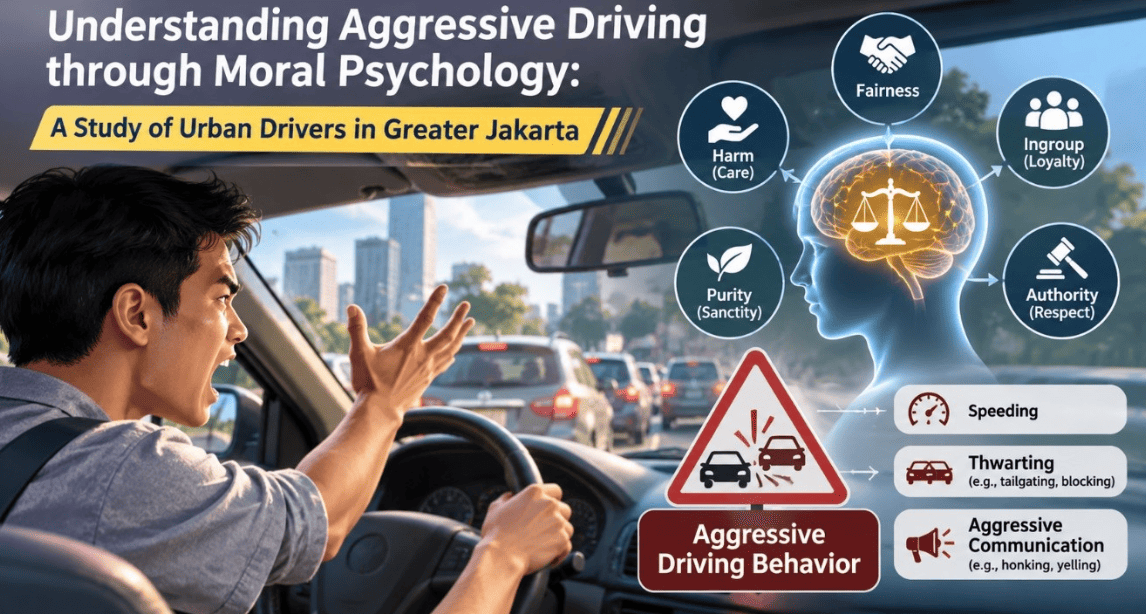
Aggressive driving is a growing concern in urban transportation, particularly in metropolitan areas where traffic congestion, time pressure, and interactions among road users create stressful driving environments. Beyond traffic regulations and road conditions, psychological factors may also influence how individuals behave behind the wheel. Understanding why some drivers respond aggressively to traffic situations is therefore important for promoting safer roads and protecting the well-being of all road users. Addressing this issue, a research study entitled “Moral Foundations Theory as a Predictor of Aggressive Driving Behavior” explores the relationship between individual moral values and aggressive driving behavior among urban drivers in Greater Jakarta, Indonesia.
The study was conducted by Gracelynne Precia and Muhamad Nanang Suprayogi from BINUS University. It draws on Moral Foundations Theory (MFT), developed by Jonathan Haidt, which proposes that human moral judgments are shaped by intuitive responses across five fundamental domains: harm, fairness, ingroup loyalty, authority, and purity. Rather than relying exclusively on conscious reasoning, individuals often respond intuitively to situations before rationalizing their decisions. Applying this perspective to driving behavior, the researchers examined whether differences in moral foundations could help explain why individuals engage in aggressive driving practices.
Driving is not merely a technical activity but also a form of social interaction in which individual decisions can directly affect the safety and well-being of others. Aggressive driving may take various forms, including speeding, obstructing other drivers, tailgating, and hostile verbal or nonverbal communication. Such behaviors can emerge in response to traffic congestion, frustration, perceived unfairness, or provocation from other road users. From a moral psychology perspective, drivers may interpret the same traffic situation differently depending on their underlying moral concerns. For example, one driver may perceive another person’s actions as unfair, while another may interpret the same behavior as a potential threat to safety or a violation of traffic rules.
To investigate this relationship, the researchers collected data from 103 urban drivers in the Greater Jakarta area. The study employed two psychological instruments: the Moral Foundations Questionnaire-20 (MFQ-20), which measures the five dimensions of moral foundations, and the Aggressive Driving Behavior Scale (ADBS), which assesses three dimensions of aggressive driving: speeding, thwarting, and aggressive communication. The collected data were analyzed using multiple linear regression and independent samples t-tests to examine the predictive relationship between moral foundations and aggressive driving behavior, as well as potential gender differences.
Interestingly, the findings revealed that the five moral foundations did not significantly predict any of the three dimensions of aggressive driving behavior. Harm, fairness, ingroup loyalty, authority, and purity were not statistically significant predictors of speeding, thwarting, or aggressive communication. The study also found no significant gender differences in overall moral foundation scores or aggressive driving behavior. These findings suggest that general moral values alone may not be sufficient to explain why individuals engage in aggressive driving practices. Importantly, this does not mean that morality is irrelevant to driving behavior, but rather that its influence may be more complex and dependent on specific circumstances.
The researchers further suggest that moral foundations may influence how drivers interpret and evaluate traffic situations rather than directly determine their behavioral responses. For instance, a driver may recognize another driver’s action as unfair or disrespectful but may not necessarily respond aggressively. The eventual response may depend on other psychological and situational factors, including anger, frustration, emotional regulation, risk perception, time pressure, and traffic congestion. These findings highlight the importance of examining aggressive driving through a broader psychological perspective that considers the interaction between individual moral orientations, emotional experiences, cognitive processes, and environmental conditions. The study also recommends strengthening road safety education, promoting emotional regulation while driving, improving traffic management, and implementing consistent law enforcement to reduce aggressive driving behavior.
This research contributes to the development of traffic psychology by exploring the relationship between morality and driving behavior within the Indonesian urban context, particularly in Greater Jakarta. The findings offer an important perspective for understanding that safe driving requires more than general moral awareness; it also involves the ability to regulate emotions, respond appropriately to challenging situations, and consider the safety of other road users. The research article, entitled “Moral Foundations Theory as a Predictor of Aggressive Driving Behavior,” was accepted and presented at the WE ARE Student International Conference 2026, held at BINUS University, Alam Sutera Campus, on 23–25 November 2026. This achievement reflects the commitment of the Department of Psychology, BINUS University, to fostering research engagement and providing opportunities for students and faculty members to contribute to international academic discussions.
Dibuat oleh : Muhamad Nanang Suprayogi, S.Psi, M.Si, Ph.D
Comments :