


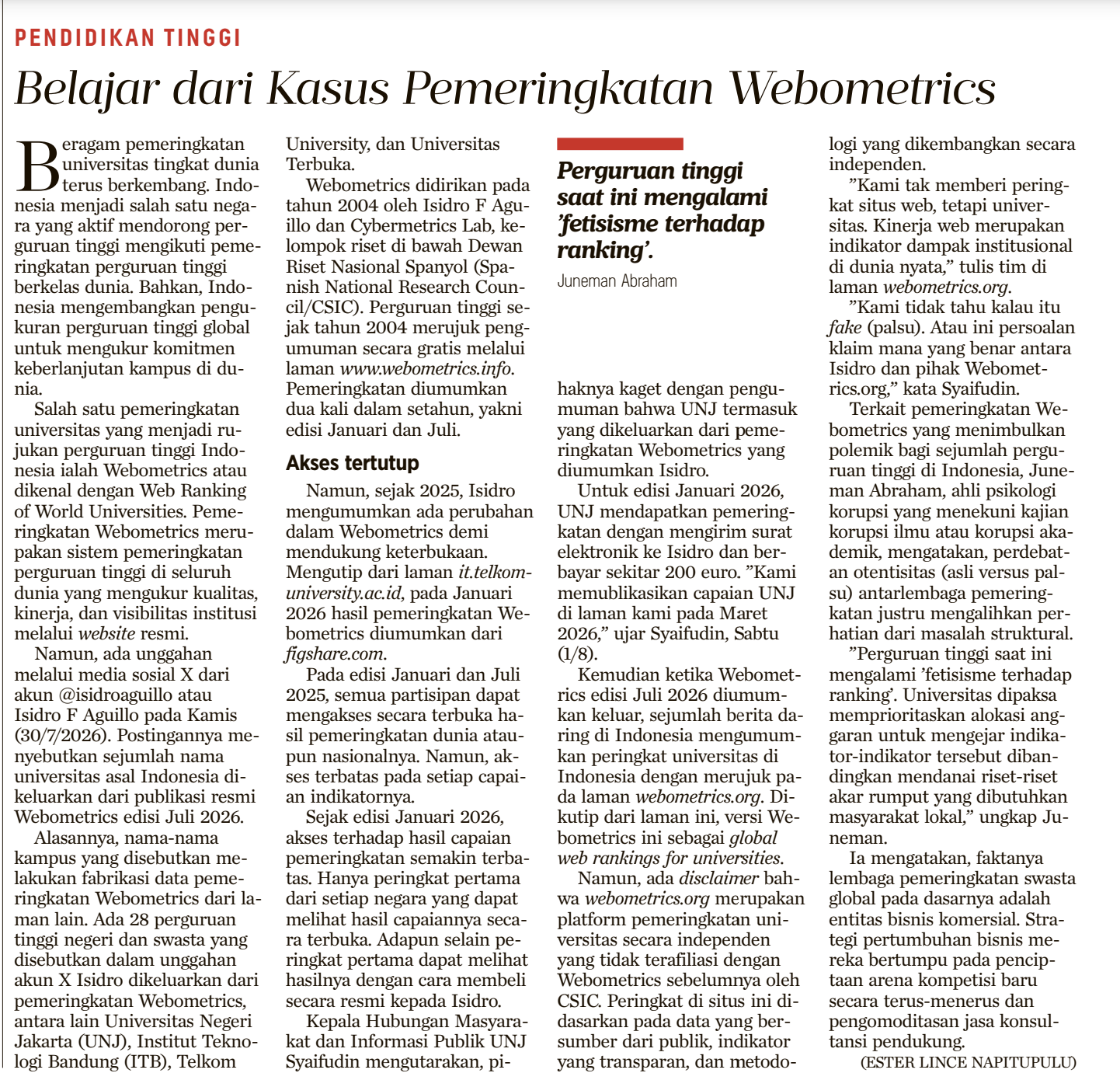
RE: Learning from the Case of Webometrics World University Rankings
Pursuing world rankings is a target for many universities in Indonesia. However, it is emphasized that higher education institutions should have a greater impact on the interests of society and the nation.
Various world university rankings continue to evolve. Indonesia has become one of the countries actively encouraging higher education institutions to participate in global university rankings. In fact, Indonesia is developing a global higher education measurement to assess the commitment to sustainability of campuses worldwide.
One of the university rankings used by Indonesian universities is Webometrics, also known as the Web Ranking of World Universities. The Webometrics ranking is a global university ranking system that measures the quality, performance, and visibility of institutions through their official websites.
However, there was a post on social media X from the account @isidroaguillo or Isidro F Aguillo on Thursday (30/7/2026). His post mentioned several names of universities from Indonesia that were removed from the official Webometrics publication for July 2026.
The reason is that the names of the universities mentioned engaged in data fabrication for the Webometric ranking from other sources. Similar actions were also taken against other countries that published Webometrics rankings that were not the Isidro version.
Webometrics was founded in 2004 by Isidro F Aguillo and Cybermetrics Lab, a research group under the Spanish National Research Council (CSIC). Since 2004, universities have been referring to the announcements for free through the www.webometrics.info page. The rankings are announced twice a year, namely the January and July editions.
Closed access
However, since 2025, Isidro announced changes in Webometrics to support openness. Quoting from the page it.telkomuniversit., ac.id, in January 2026 the Webometrics ranking results were announced from figshare.com.
In the January 2026 edition, the Webometrics ranking included more than 32,000 higher education institutions worldwide, including both public and private universities in Indonesia.
In the January and July 2025 editions, all participants will have open access to their world and national rankings. However, access is limited to each of their indicator achievements.
Since the January 2026 edition, access to ranking results has become increasingly limited. Only the first-ranked country in each ranking can view their results publicly. Those not in first place can view their results by officially purchasing them from Isidro F. Aguillo.
There are 28 public and private universities mentioned in the post from the X account Isidro that have been removed from the Webometrics ranking, including Universitas Negeri Jakarta (UNJ), Institut Teknologi Bandung, Telkom University, Universitas Terbuka, and Universitas Islam Negeri Alauddin Makassar.
The Head of Public Relations and Information at Jakarta State University (UNJ), Syaifudin, in Jakarta, on Saturday (1/8/2026), expressed that they were surprised by the announcement that UNJ was among those excluded from the webometrics ranking announced by Isidro.
For the January 2026 edition, UNJ obtained its ranking by emailing Isidro, paying around 200 Euros. “UNJ emailed Isidro and sent him the ranking for the January 2026 edition. It cost money to receive it. We published UNJ’s achievements on our website in March 2026,” he said.
On the official UNJ website, it is stated that based on official data received by UNJ on March 31, 2026, via email from Isidro F Aguillo, Head of the Cybermetrics Laboratory (Scimago Group) at the Institute of Public Goods and Policies – Spanish National Research Council (IPP-CSIC).
The position of Universitas Negeri Jakarta has significantly surged in the Webometrics Ranking of World Universities for the January 2026 edition. UNJ is ranked 2,148 globally, a sharp increase from its position of 3,858 in the July 2024 to January 2025 edition. UNJ is ranked 32 nationally.
Then, when the July 2026 edition of Webometrics was announced, several online news outlets in Indonesia announced university rankings in Indonesia by referring to the webometrics.org page. Quoted from this page, this version of Webometrics is a global web rankings for universities.
However, there is a disclaimer that Webometrics.org is an independent university ranking platform that is not affiliated with the previous Webometrics by CSIC. The rankings on this site are based on publicly sourced data, transparent indicators, and independently developed methodologies.
“We don’t rank websites, but universities. Web performance is an indicator of institutional impact in the real world,” the team wrote on webometrics.org.
A total of 3,695 Indonesian universities were included in the July 2026 edition of the list, including UNJ, which ranked 893rd in the world or 18th in Indonesia. “We don’t know if it’s fake. Or is it a matter of which claim is true between Isidro and webometrics.org.
“From various media reports regarding the publication of rankings referring to webometrics.org, we then created a story. However, after the news was published on the UNJ website, an hour later we took down or deleted the news due to information about the dispute over Webometrics,” said Syaifudin.
According to Syaifudin, the Webometrics case suggests that UNJ is no longer focused on Webometrics rankings. The university did not register for this ranking, merely accepting the ranking results, which were previously published for free on the Webometrics.info website, which is now said to be no longer part of Isidro Webometrics.
Target Top 500 in the world
Regarding the ranking of Indonesian universities on a global scale, the Ministry of Higher Education, Science, and Technology targets to be among the top 500 universities in the world. The focus is on the QS World University Ranking, Times Higher Education (THE), and THE Sustainability Impact Ratings.
In mid-2025, Indonesia recorded a 46 percent increase in its higher education institutions’ rankings in the QS World University Ranking. This achievement serves as a starting point for the Ministry of Education and Technology to strengthen its strategy for a collaborative, inclusive, and globally impactful transformation of higher education.
At that time, the Minister of Higher Education, Science, and Technology, Brian Yuliarto, reminded that efforts to pursue world rankings should not compromise academic integrity.
“There must be collaboration and blending between campuses and among our universities. We must ensure cooperation is as fluid as possible so that we can all move forward. Please, don’t let this ranking lead to fraud. If we research seriously, consistently, and patiently, the results will definitely be good,” he said.
In the pursuit of becoming a world-class university, the University of Indonesia (UI) is the only higher education institution in Indonesia that has made it into the top 200 rankings. According to the QS World University Rankings 2026, UI is ranked 189th in the world. President Prabowo Subianto aims for UI to break into the top 100 globally.
Universitas Indonesia has also been able to develop a global sustainable campus ranking through UI GreenMetric since 2010. Through a data-based ranking system, UI GreenMetric has now captured 1,745 universities from 105 countries, making it one of the largest higher education sustainability networks in the world.
Regarding the Webometrics ranking that has sparked controversy among several universities in Indonesia, Juneman Abraham, an expert in corruption psychology who focuses on the study of academic corruption, stated that the debate over authenticity (genuine versus fake) among ranking institutions actually diverts attention from structural issues.
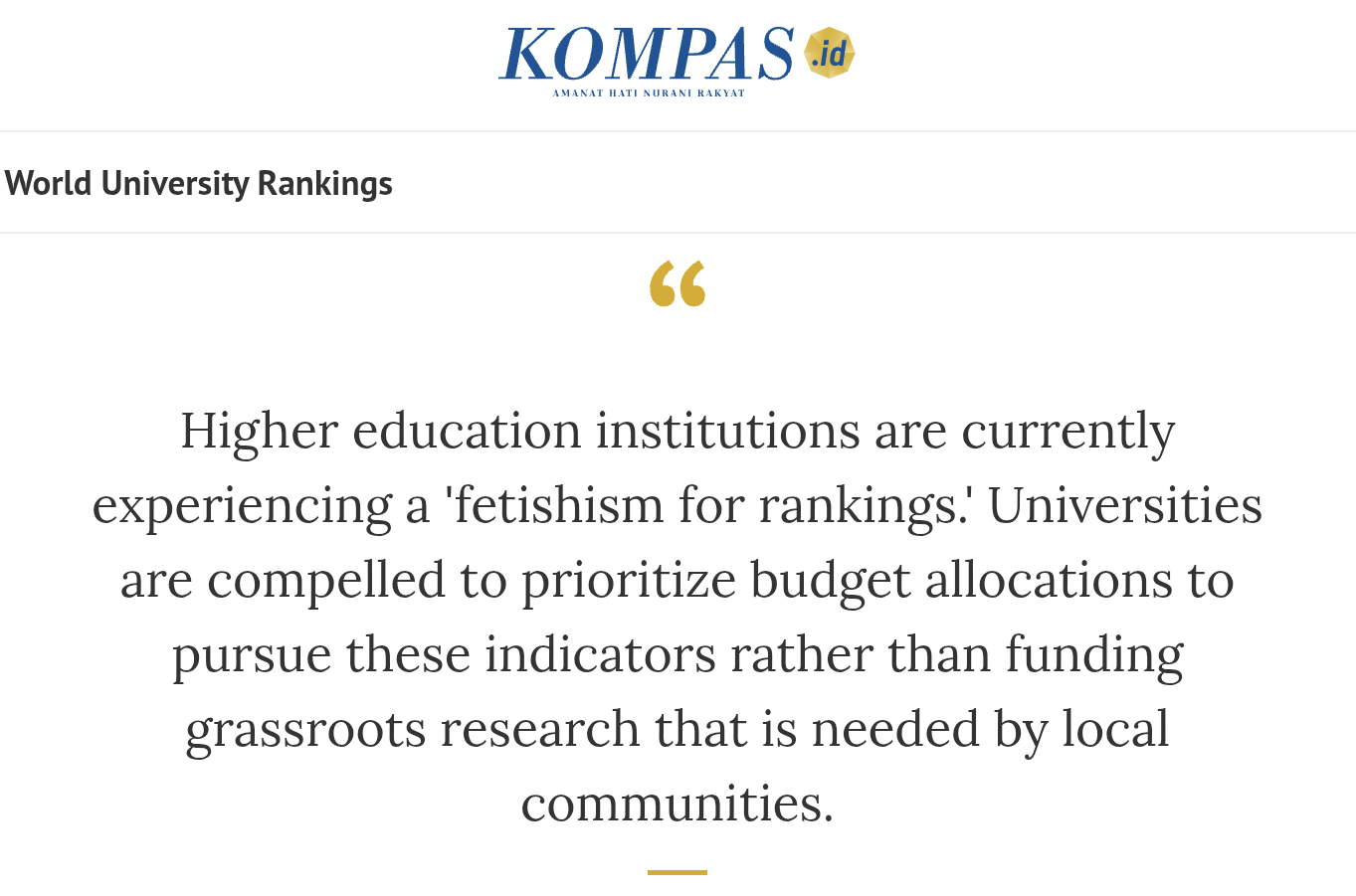
“Currently, higher education institutions are experiencing a ‘fetishism for rankings.’ Universities are compelled to prioritize budget allocations to pursue these indicators rather than funding grassroots research that is needed by local communities,” he stated.
Juneman stated that, in fact, global private rating agencies are essentially commercial business entities. Their business growth strategy relies on the continuous creation of new competitive arenas and the commodification of supporting consultancy services.
“Agencies exploit campus weaknesses or fears of a ranking downgrade to sell solution packages. This monetization encompasses several key business lines, such as paid audits and ratings, event partnerships (such as summits) and sponsored promotions, as well as consulting and data analysis services,” Juneman said.
One solution is for the government to revise the Ministerial Decree regarding key performance indicators for higher education institutions by removing explicit targets that tie university performance to ranking positions. Matching funds or incentives for higher education institutions should no longer be based on ranking jumps in commercial rating agencies.
“It is better to focus on the real impacts of research on solving national issues, food sovereignty, energy, health, and inclusive access to education,” emphasized Juneman.
Writer: Ester Lince Napitupulu| Editor: Evy Rachmawati . Kompas.id https://www.kompas.id/artikel/learning-from-the-webometrics-world-university-ranking-case
Comments :