



The Wild Robot (2024) : From Unit 7134 to a Mother of a Gosling
Directed by Chris Sanders and adapted from Peter Brown’s 2016 novel, The Wild Robot is a profound exploration of how consciousness emerges through connection. It tracks the evolution of a machine as it overrides logical algorithms to complete its task through radical acts of empathy. It is a story the proves personhood is not found in a motherboard, rather in the messy, un-programmable findings of love.
The story begins not with a character, but with a product: ROZZUM 7134. In this initial stage, the machine is defined by instrumental value, a unit exists solely to perform tasks for “users”. When Roz first washes ashore to an island, her introduction is a rigid protocol of corporate utility, programmed to solve problems through cold calculation. At this point, Roz was an “it”, a blank slate of circuitry.
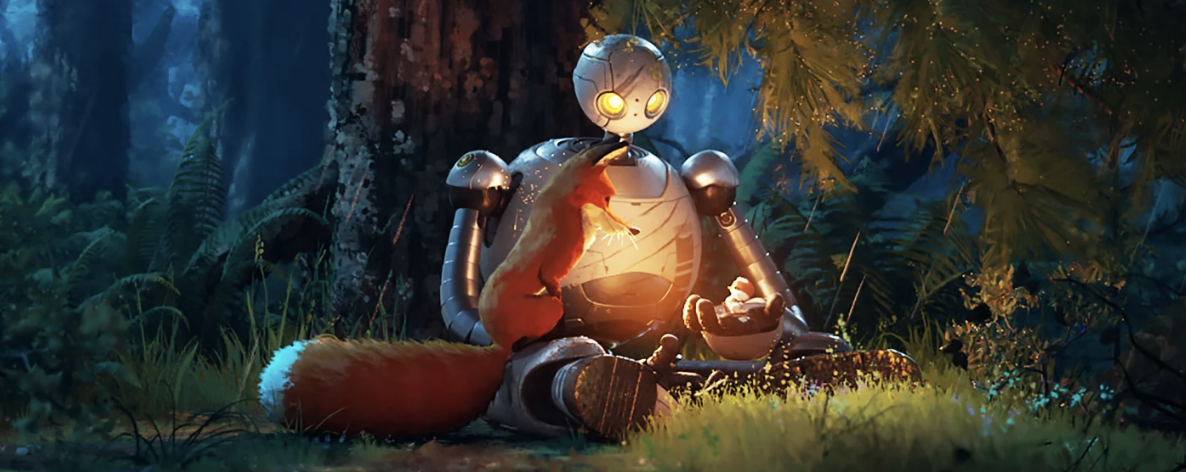 Sumber: Dreamwork
The island, however, is a chaotic ecosystem that doesn’t recognize serial numbers. To the animals, Roz was a “monster” of metal, an anomaly in a world governed by the law of the claw and the wing. Being a machine searching for a user in a wilderness that has no use for a servant. To survive, Roz must move beyond its factory settings, transitioning from a static processor of data to an active agent in her environment. To adopt the language of the island and imitate movements of its inhabitants, she undergoes her first “software update”. This agentic perspective (Bandura, 2001) allows her to stop simply reacting to environmental stimuli and begins to purposefully navigate, improvise on solutions.
The shift from “Unit” to “Roz” is triggered by a “glitch” that no programmer could have anticipated: the necessity of care. This system instability occurs when Roz becomes responsible for an orphaned gosling she names Brightbill. With the help of Fink, a fox self-proclaimed goose expert and experienced on survival, a fundamental conflict arises between her hardcoded logic and the unpredictable demands of nurturing. Nature does not provide a manual for motherhood, and Roz’s survival protocols offer no guidance on how to keep a fragile being to eat, swim and fly in time for migration.
This evolution is a lived example of relational being. As Gergen (2009) argues, human essence and identity are not located within the individual but within the relationship itself. Roz does not have any “Parenting” pre-installed in her circuits, instead she learns it through her interaction with others. From Pinktail the opossum, who unintentionally provides “scaffolding” for Roz to understand Brightbill’s biological needs. Then Fink the fox who evolves from a cynical guide to a loyal friend that offers help raising Brightbill. Through these relational bonds, Roz’s identity is redefined, she transcends from a machine “seeks to complete a task” toward “pursuit of purpose.”
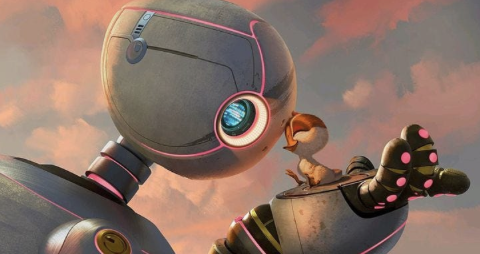
“I am ROZZUM 7134… But you can call me Roz”
Ultimately, Roz’s journey suggests that personhood may not be a biological status, but a moral achievement. In the story, she proves that a heartbeat is not a prerequisite for having a heart. Following John Locke’s (1975) view that personhood requires a “thinking, intelligent being, that has reason and can consider itself as itself.” Roz “glitches” from kindness, sacrifice, and maternal instinct are actually the most sophisticated expression beyond her programming. By the time her corporate counterparts arrive to reclaim their “property”, she tells them “I am already home”, she has redefined the concept of “home” from geographical coordinate to an emotional state of belonging. Roz ceases to be a unit of labor and becomes a pillar of a community. In the end, Rozzum 7134 is not deleted by factory reset, but by the overwhelming emergence of Roz: a mother, a friend, and a wild autonomous soul.
References:
Bandura, A. (2001). Social Cognitive Theory: An Agentic Perspective. Annual Review of Psychology, 52(1), 1-26.
Brown, P. (2016). The wild robot. Little, Brown and Company.
Gergen, K. J. (2009). Relational Being: Theoretical Foundations for Personal Life. Oxford University Press.
Locke, J. (1975). An Essay Concerning Human Understanding (P. H. Nidditch, Ed.). Oxford University
Sanders, C. (Director). (2024). The Wild Robot [Video]. DreamWorks Animation.
Writer: Kezia Ho – 2702227151
Editor : Andrea Prita Purnamasari
Comments :