



The Crippling Insecurity We Live of Imposter Syndrome
We all have that one person that we idolize whether a mentor, an artist or a professional whose skills are almost out of this world. You watch their work, the marks they leave impact on this very surface and think “I could never achieve that.” Yet, as time passes, you might find yourself in the very position you once admired. But instead of feeling like the greatest success you have ever reached, nagging thoughts take root: “It’s not enough. You aren’t enough.”
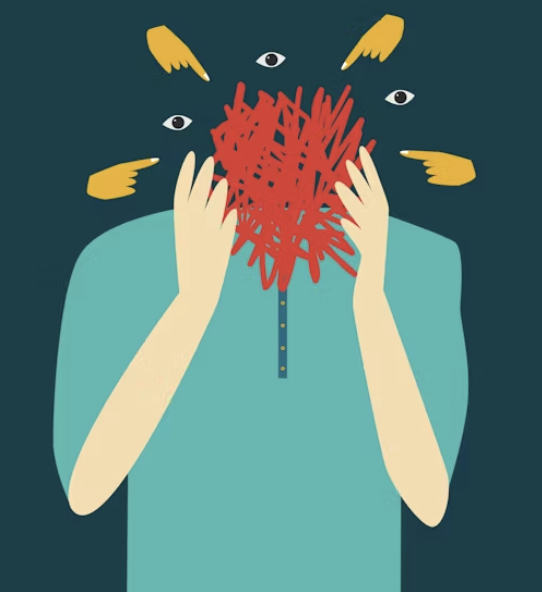 Sumber: https://unsplash.com/illustrations/overwhelmed-person-experiencing-many-pressures-and-stares-VfLYsgr80Q8
This is the core of Imposter Syndrome, originally known as the “Imposter phenomenon” by psychologist Pauline Clance and Suzanne Imes in 1978. It refers to an internal experience of doubting one’s ability, even when the present evidence shows how capable they are in their environment. You may have nagging internal voices that insist your achievements weren’t rightfully earned by your effort. Believing the negative internal voices could lead to self-destructive acts whether they push themselves or withdraw.
Perhaps in your early years of life in school and at one point we think progress is something linear, like climbing a well constructed staircase. You study, you get the grade, and you move up. But as we move into more professional or work fields, that rhythm breaks. Suddenly, the milestones feel less defined. Instead of getting the sense of mastery after accomplishment, it felt like new plant seeds of doubt and latched onto you like pesky weeds. Begin to fear that the higher you climb, the further you have to fall.
However we are not entirely aware of the distance in admiration. When we look at the people we looked up to, we see their greatest known contribution to society, the “beautiful masterpiece” in grand displays, and most of the finished products. We don’t see the years of messy drafts, failed attempts or when they spiral. Because little is realized, we only see their highlights, none of the “behind the scenes” of the trial and error our heroes face. Stuck up with the idea of perfection, we stop taking risks, fearing a single mistake will “expose” us. We unconsciously choose to withdraw, to avoid the perceived humiliation of failure. With this knowledge in mind, if you are currently feeling like a fraud in your own life, this phenomenon is a byproduct of growth. It is a sign that you are pushing boundaries and your own limits. By recognizing these internal voices not as were facts, but as evidence that you are challenging yourself.
Reference:
Ali, E. S., Kurniawati, Y., & Nurwanti. R., (2015). Peran Impostor Syndrome dalam Menjelaskan Kecemasan Akademis pada Mahasiswa Baru. Mediapsi https://doi.org/10.21776/ub.mps.2015.001.01.1
Clance, P. R., & Imes, S. A. (1978). The imposter phenomenon in high achieving women: Dynamics and therapeutic intervention. Psychotherapy: Theory, Research & Practice, 15(3), 241–247. https://doi.org/10.1037/h0086006
Writer: Kezia Ho – 2702227151
Editor : Editor : Andrea Prita Purnama Ratri
Comments :