



Schizophrenia and it’s Symptoms
First things first, what exactly is schizophrenia? Simpler definition will tell you that schizophrenia is a disorder characterized by disturbance in thought, emotion, and behavior. It may be disordered thoughts, such as illogical ideas, faulty perception and attention, disturbance in movement, and even inappropriate emotional expressions. These symptoms very well interfere with life, whether it is maintaining a stable employment or maintaining relationships with others. With how challenging it is to maintain a stable life with schizophrenia, it is to be recognize the heightened risk of suicide within the people with this condition. While suicide rate is high, it is stated that people with schizophrenia are also more likely to die from any causes. Other known facts about schizophrenia is that its lifetime prevalence is slightly less than 1 percent, and that it affects men slightly more than it affects women.
:max_bytes(150000):strip_icc():format(webp)/what-are-the-symptoms-of-schizophrenia-2953120-e15ca22957ec44ff8969cf9b8ac24568.jpg)
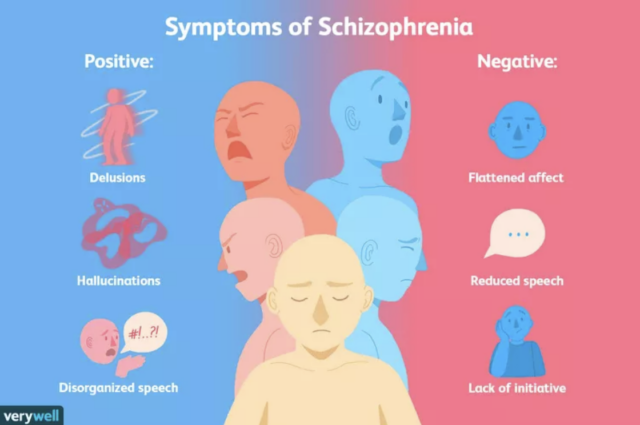
Diagnosis for schizophrenia is not limited to a single essential symptom, it varies from one another quite a bit. Some researchers divided these symptoms into two, positive symptoms and negative symptoms. Later, the positive symptoms are then divided again into positive and disorganized. One of the positive symptoms include delusions, which are beliefs that are contradictory to reality. Some forms of delusions also includes:
- Thought insertion, where individuals believe that the thoughts formed in their mind are not their own thoughts, but from external sources.
- Thought broadcasting, where individuals believe that other people can see what they are thinking, or that their thoughts are being broadcasted or transmitted to others.
- Individuals that believe their thoughts are being controlled by external forces.
- Grandiose delusions, where individuals delusion themselves and exaggerate their identities to be more than it is.
- Individuals may have ideas of reference, where individuals delude themselves that other’s trivial activity or unimportant events are always about them.
Other positive symptoms are hallucinations and other disturbances of perception. Hallucination, also a disturbance of perception, the most dramatic one at that, is where individuals sense something when there is actually no simulation from the environment, such as hearing things even though there is actually nothing making the sound, seeing things that are not there, etcetera. It is said that individuals with schizophrenia experience auditory hallucination more often than visual hallucination.
Next symptoms of schizophrenia is the negative symptoms which consist of behavioral deficits, such as:
- Avolition or apathy, where individuals lack motivation and absence of interest, which may lead to inability to persist in their daily routine.
- Asociality, where individuals experience severe impairments in social relationships, and so may prefer to spend time alone.
- Anhedonia, where individuals lose interest in pleasure or feel less pleasure.
- Blunted affect, where individuals lack outward expression of emotion, but not inner emotions. Which means, they may feel happy inside, but deadpan on the outside.
- Alogia, where individuals experience a significant reduction in amount of speech, in which they just do not talk much.
The last symptoms are disorganized symptoms, which includes disorganized speech, which is also known as formal thought disorder, is when an individual experience problem in organizing ideas and thoughts, so when they are speaking, it can be difficult to understand, and disorganized movement, which is when an individual experience disturbance in movement behavior. An example of this is catatonia, but it is said that catatonia is rarely seen nowadays.
Written by: Leandra Lagunara
Comments :